
For the fabrication of aspheric optical surfaces, several geometric parameters are required to ensure correct generation and processing. In particular, the asphericity—defined as the deviation of the optical surface from a perfect sphere—and the radius of the removal sphere—the enveloping spherical surface located outside the material that does not intersect the surface to be generated—are essential inputs. These parameters can be calculated from the asphere coefficients shown below in combination with the clear aperture.
In addition, optics fabrication requires knowledge of the smallest radius of curvature, which represents the maximum local curvature or bending present on the surface. This value can likewise be derived from the same asphere parameters and the clear aperture and is critical for determining manufacturability and tool selection.
For off-axis aspheres or axicons, the calculator can be adapted by selecting the appropriate asphere type and specifying the parameters x0 and x1, which define the start and end coordinates along the x-axis over which the surface is evaluated.

Disclaimer:
Please counter-check the results. Despite thorough controls by our means, errors are possible. Use at your own risk(GTC applies).
Additonal notes:
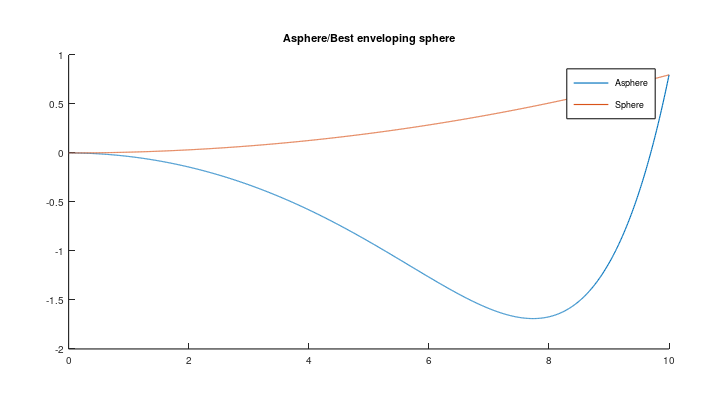
Please note, that the converter assumes that the material is always below the curve. For example, if we use R=-14, C=5e-08, Clearaperture=20 and 0 for all other parameter we get the blue asphere and the red best enveloping sphere in the following picture. The material would be below the blue curve.
Next steps:
If you want to check your lens data for fabrication or get a cost estimation, you need the PanDao tool. Create a free account!!